
Running Cadence and Injury Prevention: Does It Actually Matter?
Running cadence gets mentioned as a "fix" for every running related injury. Some people even talk about running at the “perfect” cadence. This post will cover the research and real world application of running cadence and whether it actually makes a difference for injuries.
What Is Running Cadence?
Running cadence is the number of steps you take per minute while running and is measured in steps per minute.
You can measure yours right now without any equipment. Count your steps over 30 seconds at your normal pace and multiply by two. Or record yourself on a treadmill at a comfortable speed and count from the video. If you use a Garmin or other smartwatch, it's already doing this for you. Pull up your stats after a run and you'll see a cadence graph and your average for that workout.
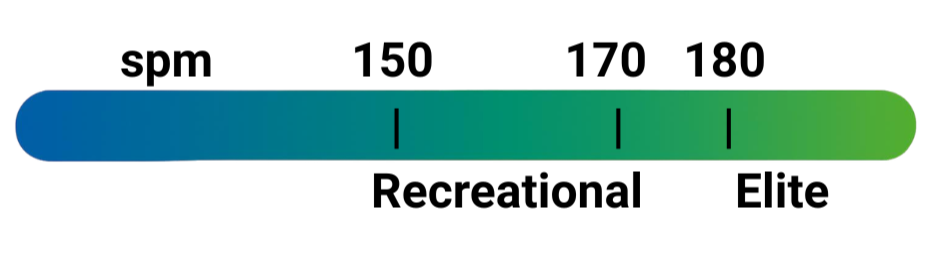
Cadence typically ranges from 130 to 200 steps per minute (spm). Recreational runners usually fall somewhere in the 150 to 170 spm range. Elite runners tend to hit 180 spm and above.
Which raises an obvious question- is that just because elite runners run faster?
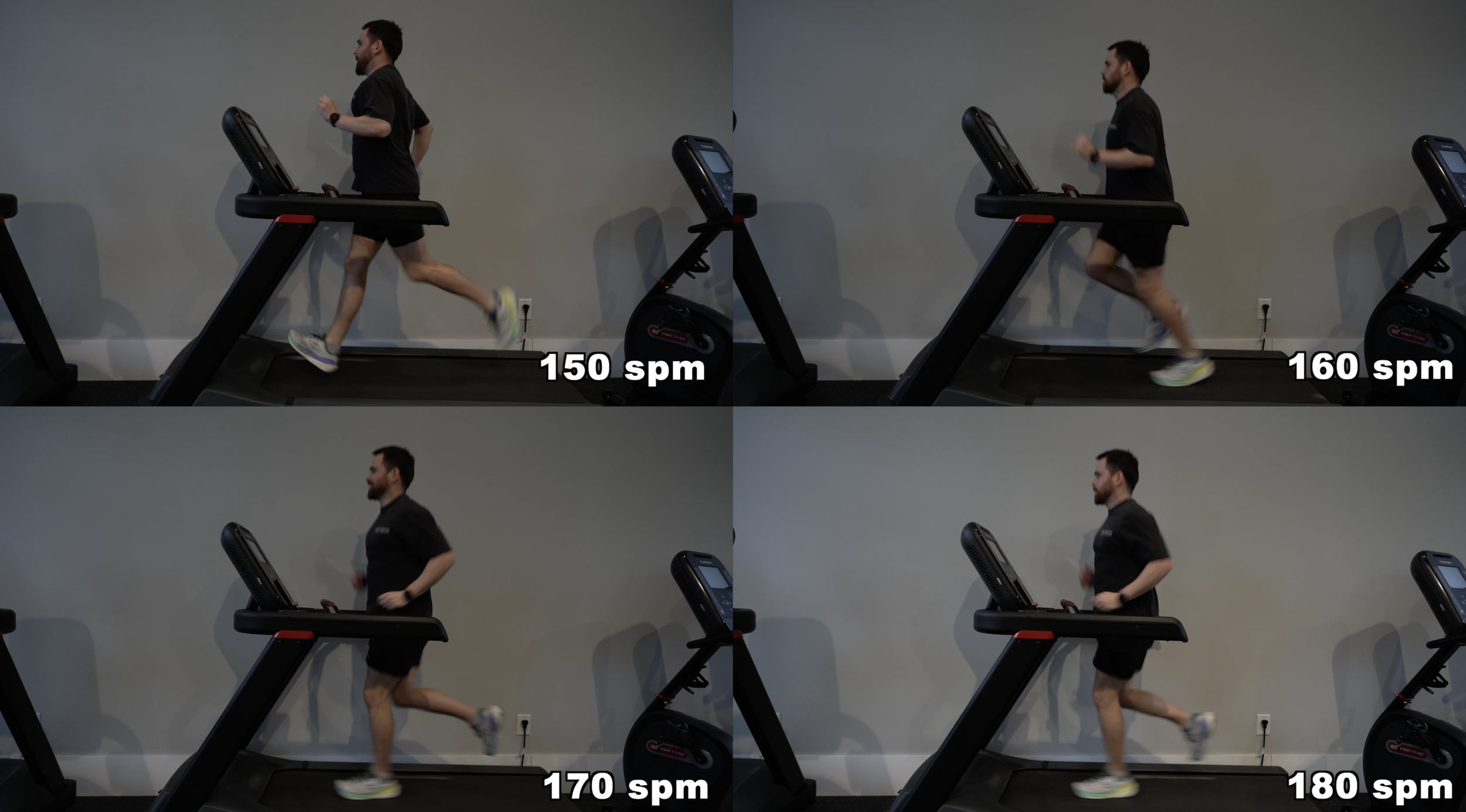
Yes and no. You need a higher cadence to run fast, but at slower speeds you can actually adjust your cadence independently of pace. You cadence will naturally ebb and flow depending on multiple variables. Check out the video at the end of this article for a visual demonstration.
Does a Higher Cadence Cost More Energy?
You might be thinking, “if I'm taking more steps over the same distance, doesn't that make me more tired?”
Actually, not really. A 2025 systematic review Figueiredo and colleagues showed no negative changes in running economy or metabolic cost with up to moderate changes in cadence. Some studies from that paper have even found slight improvements because shorter loading phases mean less energy spent absorbing the ground with each step.
What Does Cadence Have to Do With Injury Prevention?
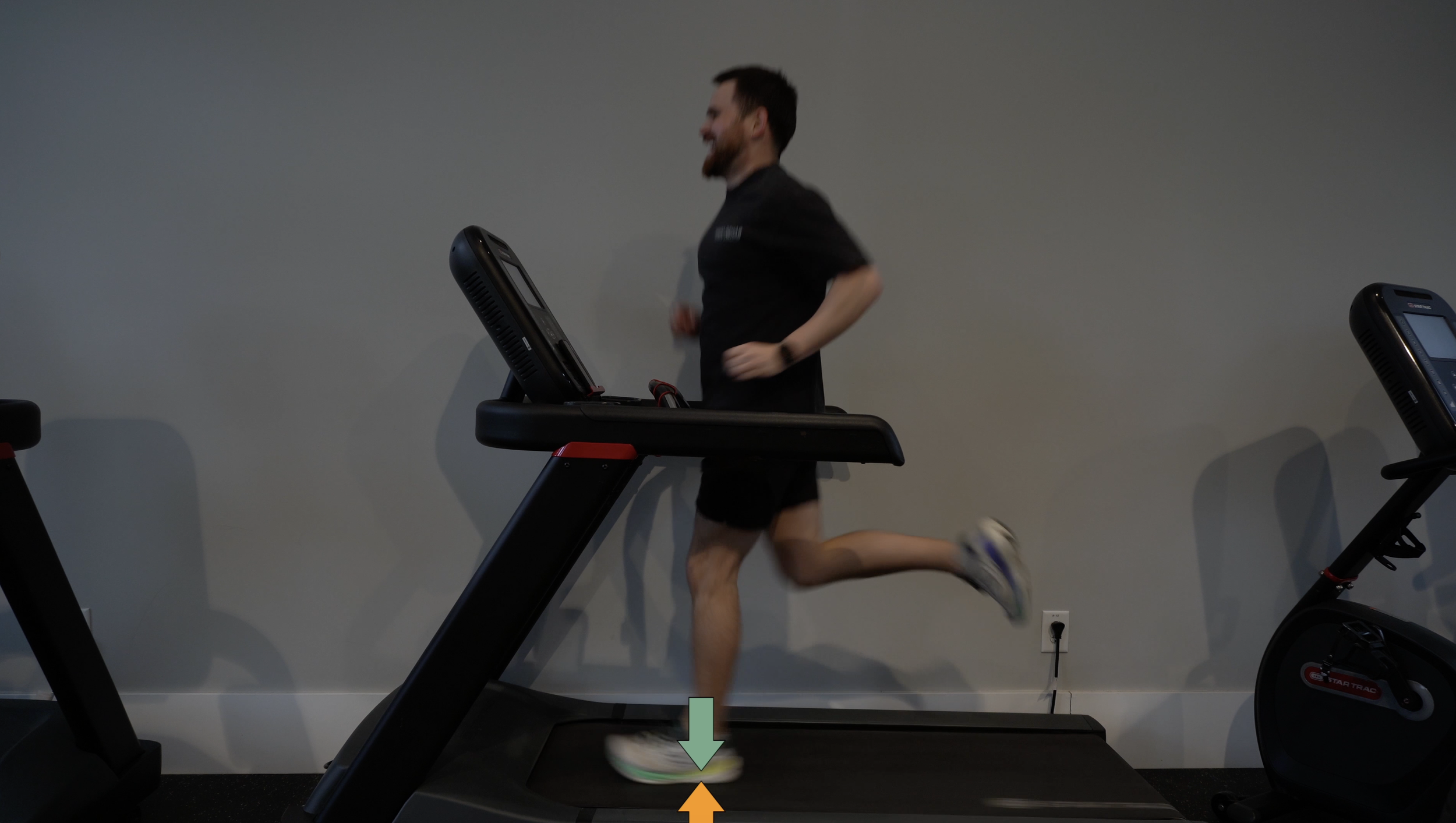
Every time your foot hits the ground, your joints, bones, muscles, tendons, and other structures have to absorb and transmit those forces. In general, the longer you spend on the ground, and the longer your time in the air, the greater the reaction forces your body has to handle. Lower cadences can essentially mean hitting the ground harder with each step.
That same systematic review by Figueiredo et al found that found that increasing cadence by just 5 to 10% significantly changes your running biomechanics, reducing ground reaction forces, lowering loading rates, shortening stride length, and decreasing hip adduction, which puts the knee in a better loading position. The result is less stress through the hips, knees, and ankles.
For runners dealing with bone stress injuries or patellofemoral pain specifically, studies by Nijs et all in 2020 and Heiderscheit et all in 2011 showed a reduction of up to 20% of stress through the knee from a 5 to 10% cadence change alone. One randomized control trial by Chang et all in 2018 even found that increasing cadence was associated with fewer injuries overall.
The research is still growing and more studies are needed. Remember that running related injuries are complicated and multifactorial. Running cadence is just one piece of a bigger picture.
How to Actually Increase Your Cadence
Start conservatively. Aim for a 5% increase first and see how you feel before going further.
Metronome app. The boring but easy option. Download any free metronome app, set it to your target cadence, and use it as an audio cue during your run. Not that exciting, but it works.
Music. Search various websites or music playlists at your target cadence in beats per minute. Say my usual cadence is 157 spm and I want to bump it up 5% to 165 spm- find some music at 165 beats per minute and incorporate it into your run. Research by Erin Lalley in her colleagues in 2025 has shown music is an effective auditory cue for hitting a target cadence, with the added benefit of improving compliance and enjoyment. Plus running with music may even help with performance because it may help shift focus away from physiological factors such as increased heart rate and respiration
Some caveats with cadence training for music: some people are better than others at staying on the beat and sometimes music changes tempo throughout the song.
Garmin cadence alerts. This is the option I find most useful with the runners I work with. You can program cadence directly into a Garmin workout as a performance metric, and the watch will vibrate or alert you when you fall outside your target range and stop alerting when you're back in range. It's objective, automatic, and easy to set up.
The most practical way to implement this: use cadence targets during specific intervals of a run rather than the whole thing. That way you're checking in on your mechanics in segments, not thinking about your step rate for every single stride.
So Do You Actually Need to Change Your Cadence?
Maybe.
If you're running at a lower cadence, say around 150 spm, and you've been dealing with patellofemoral pain or recurring knee problems, it's worth experimenting with a 5 to 10% increase. It can also be a useful intervention for runners whose mechanics have been altered by a chronic injury.
If you're running pain free with no real injury history, chasing a higher number isn't necessarily going to make you a better or safer runner.
The Bottom Line
You don't need any fancy gear to work on this, but consistency matters. Gains can fade over time if you don't maintain them. It's worth checking your cadence periodically, seeing if you're in a reasonable range that works with you, and doing a bit of cadence work to refresh it when needed. Adjustments in cadence may have a significant impact on those with injuries or a biomechanical issues.
References
Anderson, L. M., Martin, J. F., Barton, C. J., & Bonanno, D. R. (2022). What is the effect of changing running step rate on injury, performance and biomechanics? A systematic review and meta-analysis. Sports Medicine - Open, 8(1). https://doi.org/10.1186/s40798-022-00504-0
Chan, Z. Y., Zhang, J. H., Au, I. P., An, W. W., Shum, G. L., Ng, G. Y., & Cheung, R. T. (2018). Gait retraining for the reduction of injury occurrence in novice distance runners: 1-year follow-up of a randomized controlled trial. The American Journal of Sports Medicine, 46(2), 388–395. https://doi.org/10.1177/0363546517736277
Conley, D. L., & Krahenbuhl, G. S. (1980). Running economy and distance running performance of highly trained athletes. Medicine & Science in Sports & Exercise, 12(5), 357–360.
Doyle, E., Doyle, T. L. A., Bonacci, J., & Fuller, J. T. (2022). The effectiveness of gait retraining on running kinematics, kinetics, performance, pain, and injury in distance runners: A systematic review with meta-analysis. Journal of Orthopaedic & Sports Physical Therapy, 52(4), 192–205. https://doi.org/10.2519/jospt.2022.10585
Figueiredo, I., Reis, M., & Sousa, J. E. (2025). The influence of running cadence on biomechanics and injury prevention: A systematic review. Cureus. https://doi.org/10.7759/cureus.90322
Heiderscheit, B. C., Chumanov, E. S., Michalski, M. P., Wille, C. M., & Ryan, M. B. (2011). Effects of step rate manipulation on joint mechanics during running. Medicine & Science in Sports & Exercise, 43(2), 296–302. https://doi.org/10.1249/mss.0b013e3181ebedf4
Lally, E., Ericksen, H., Azen, R., Huddleston, W., & Earl-Boehm, J. (2025). In-field temporospatial gait retraining adherence improves with music auditory cueing. Journal of Sports Sciences. https://doi.org/10.1080/02640414.2025.2568250
Lally, E., Ericksen, H., Azen, R., Huddleston, W., & Earl-Boehm, J. (2025). Running step rate can be increased with both metronome and music auditory cueing. Journal of Sport Rehabilitation, 1–6. https://doi.org/10.1123/jsr.2024-0392
Nijs, A., Roerdink, M., & Beek, P. J. (2020). Cadence modulation in walking and running: Pacing steps or strides? Brain Sciences, 10(5), 273. https://doi.org/10.3390/brainsci10050273
Van Dyck, E., Buhmann, J., & Lorenzoni, V. (2020). Instructed versus spontaneous entrainment of running cadence to music tempo. Annals of the New York Academy of Sciences, 1489(1), 91–102. https://doi.org/10.1111/nyas.14528